
Information Integrity
The integrity of our information environment is fundamental to the health of democracy and effective public policymaking. Yet today’s digital ecosystems are increasingly vulnerable to low-quality, deceptive, or manipulative information—from both domestic and foreign actors, that undermines trust, polarizes citizens, and impairs collective problem-solving on critical societal challenges.
CCPP scholars investigate the factors that enhance or compromise information integrity across social and digital networks. Our research explores how influence campaigns, algorithmic amplification, and coordination dynamics shape what information people encounter and believe; how media behaviors, attitudes, and identities drive exposure to and endorsement of low-integrity content; how information ecosystems can be made more transparent and resilient; and what the societal, behavioral, and policy consequences are when information systems fail.
Recent Select Publications
- Garrett, R. K., Bond, R. M., & Nisbet, E. C. (2025). Self-Reported Exposure and Beliefs About Misinformation Across a US Presidential Election Cycle: Expressive Responding and Motivated Reasoning. Political Communication
- Nisbet, E.C. and Kamenchuk, O. (2025). Unpacking the psychology of state-sponsored disinformation operations and implications for public diplomacy counterstrategies. In S. Aday’s Handbook on Public Diplomacy. United Kingdom. Edward Elgar Publishing
- Ruijgrok, K., Berenschot, W., Gaw, F., Sombatpoonsiri, J., Wijayanto, Agonos, M. J., & Sastramidjaja, Y. (2025). Towards the Comparative Study of Domestic Influence Operations: Cyber Troops and Elite Competition in Indonesia, the Philippines and Thailand. Political Communication, 1-21.
- Osborne, M.A., Malloy, S., Nisbet, E.C., Bond, R.M., Tien, J.H. (2022). Sentinel node approach to monitoring online COVID-19 misinformation. Scientific Reports. 9832 (2022).
- Nisbet, E.C. and Kamenchuk, O. (2021). Russian news media, digital media, informational learned helplessness, and the belief in COVID-19 misinformation. International Journal of Public Opinion Research. 33 (3), 571-590
NEWS AND UPDATES ON THIS TOPIC

CCPP Director Erik Nisbet Discusses AI and Election Campaigns in NBC Chicago Interview
CPP Director Erik Nisbet recently appeared on NBC Chicago to discuss how artificial intelligence is beginning to reshape modern political campaigns as the 2026 election cycle approaches.
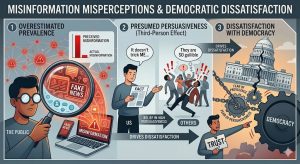
New Research Shows Perceptions of Online Misinformation May Undermine Satisfaction with Democracy
A new study by CCPP Faculty Director Erik Nisbet, CCPP graduate affiliate Chloe Mortenson, and R. Kelly Garrett (Ohio State University) examines how Americans’ beliefs about online misinformation

CCPP Faculty Affiliate Yingdan Lu Publishes New Research on Celebrity Fandom and State Propaganda
Yingdan Lu, director of the Computational Media and Politics Lab at Northwestern University and CCPP faculty affiliate, has published a new article in Political Communication

CCPP Team Presents New Paper on AI and Democracy at SPSA 2026
Faculty and graduate affiliates from the Center for Communication & Public Policy (CCPP) recently presented new research at the Southern Political Science Association 2026 Annual

This Week: CCPP’s Global Disinformation in a Post-Moderation World Symposium on Jan. 22-23
The Global Disinformation in a Post-Moderation World Symposium, co-organized by the Center for Communication & Public Policy and Northwestern University’s Roberta Buffett Institute for Global
Postdoctoral Opportunity: Global LLM Values Benchmarking Working Group
Applications are now open for a Postdoctoral Research Opportunity to join the Global LLM Values Benchmarking Working Group, a major interdisciplinary initiative in which CCPP