A recent article in Salon spotlights new research by CCPP Director Erik Nisbet and CCPP graduate affiliate Chloe Mortenson, whose study in Perspectives on Politics examines a difficult question for contemporary democracies: How strongly do citizens hold democratic principles when those principles conflict with economic self-interest? The Salon piece, “Why many Americans would trade democracy

Category: Network Democracy
CPP Director Erik Nisbet recently appeared on NBC Chicago to discuss how artificial intelligence is beginning to reshape modern political campaigns as the 2026 election cycle approaches. The segment explored the growing use of AI-generated content in campaign advertising, including tools that can replicate voices, generate images or videos, and quickly produce tailored political messages. Campaigns are
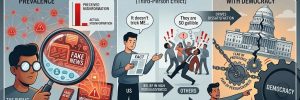
A new study by CCPP Faculty Director Erik Nisbet, CCPP graduate affiliate Chloe Mortenson, and R. Kelly Garrett (Ohio State University) examines how Americans’ beliefs about online misinformation may influence their satisfaction with democracy. The article, “The Presumed Prevalence/Persuasiveness of Online Misinformation and Americans’ Dissatisfaction With Democracy,” was recently published in Social Media + Society. Over the past
Faculty and graduate affiliates from the Center for Communication & Public Policy (CCPP) recently presented new research at the Southern Political Science Association 2026 Annual Meeting, examining how large language models (LLMs) conceptualize democracy across national and institutional contexts. The paper, Political Divergence of AI: Cross-National Differences in Large Language Models’ Perspectives on Democracy, led
CCPP faculty affiliate Olga Kamenchuk recently organized and moderated a timely webinar bringing together scholars to present new research on Ukrainian public opinion amid Russia’s ongoing war against Ukraine. The event highlighted cutting-edge survey research examining how Ukrainians perceive democracy, governance, national identity, and the war’s social and political consequences. As reported by The Daily
A new study from Northwestern University’s Center for Communication & Public Policy (CCPP), published in Perspectives on Politics, offers powerful insights into how Americans balance their commitment to democratic principles with their economic well-being, revealing that electoral support for democracy is far more conditional than standard surveys suggest. For decades, public opinion surveys have shown
Axios: Indiana’s Redistricting Rejection Could Cool Midterm Map Wars, Says CCPP Director Erik Nisbet
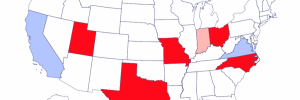
In a recent interview with Axios, Erik Nisbet, Director of Northwestern University’s Center for Communication & Public Policy (CCPP) and Owen L. Coon Professor of Policy Analysis and Communication, argues that Indiana’s decision not to pursue mid-decade redistricting could have ripple effects far beyond the state. According to Nisbet, Indiana’s move may “stop or at
Applications are now open for a Postdoctoral Research Opportunity to join the Global LLM Values Benchmarking Working Group, a major interdisciplinary initiative in which CCPP is participating, supported by the Roberta Buffett Institute for Global Affairs. This position is part of the previously announced Buffett-supported grant advancing global benchmarks for evaluating large language models (LLMs)
The Center for Communication and Public Policy (CCPP) is part of an interdisciplinary Northwestern team that has received a $200,000 award from the Buffett Institute for Global Affairs to support the Global LLM Values Benchmarking Working Group. The project includes CCPP Director Erik Nisbet and CCPP faculty affiliate Yingdan Lu, who join collaborators across communication,
The Center for Communication & Public Policy (CCPP) is proud to celebrate the outstanding work of our graduate affiliates presenting at the 50th Annual Meeting of the Midwest Association for Public Opinion Research (MAPOR), held November 21–22 in Chicago. This year’s conference theme — “Fifty Years of Measuring Change: Where we were, where we are,